شرطة الأطفال
- 4.5
- Rating
- 5.00M
- Installs
- Free
- Price

 Analysis by App-foxy
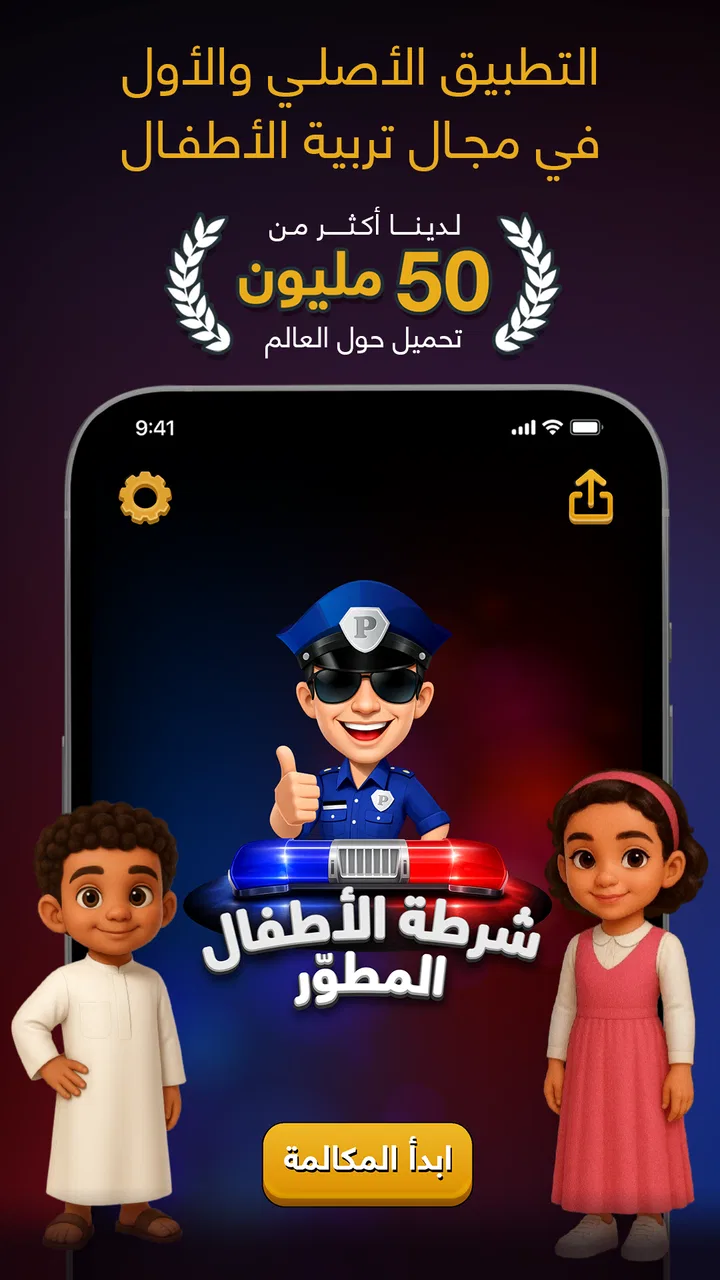
When I first opened شرطة الأطفال, I immediately understood its appeal: it turns the familiar idea of calling a “children’s police” service into a playful pretend activity for parents and young children. This is a free parenting app from Romman Smart Applications LLC, designed for Everyone, and its simple Arabic presentation makes it easy to introduce during a quiet moment at home. I would not treat it as a serious discipline tool, but as a short piece of imaginative play that can help a child pause, listen, and join a conversation.
The app has been around since October 9, 2014, and its current version is 7.11. That long presence matters because it suggests this is not a brand-new experiment that disappears after a few weeks. At the same time, its basic concept is intentionally narrow. You are not getting a complete parenting planner, educational platform, or behavior-tracking system. You are getting a focused role-play experience built around the idea of children’s police.
How the current experience feels in everyday use
The most useful way to understand this app is to imagine a normal family situation rather than a store description. A child is refusing to put away toys, delaying bedtime, or ignoring a request to stop watching a screen. Instead of immediately raising my voice, I can use the app as a theatrical interruption, let the child hear the pretend authority figure, and then return to the real conversation. The value comes from the change of mood, not from the idea that an actual police service is involved.
You May Also Like

 AccuWeather: Weather Radar
AccuWeather Review: A Quick, Clear Forecast for Everyday Decisions
For everyday plans, the best forecast is the one you can understand quickly. AccuWeather makes rain timing, radar, and local conditions easy to act on, with a few trade-offs.

 Hill Climb Racing
Why Hill Climb Racing Still Turns Crashes Into One More Run
A tiny car, a bumpy hill and one more upgrade: Hill Climb Racing keeps resurfacing because its simple chaos makes every near-miss feel personal.

 AliExpress - Shopping App
AliExpress Makes Global Shopping Feel Personal, but Shoppers Bear the Risk
AliExpress turns a global marketplace into a pocket-sized discovery engine. Its reach is useful, its shopping loop compelling, and its trade-offs easy to miss.

 Lords Mobile: Kingdom Wars
Lords Mobile Is a Kingdom-Building Routine, Not a Quick Match
A case-by-case verdict on the building, battles, device demands, and social commitments that make Lords Mobile rewarding for some players and exhausting for others.

 PDF Scanner app - TapScanner
TapScanner Makes Paperwork Easier to Capture, Check, and Share
TapScanner makes scanning with a phone feel less like a rescue operation and more like a dependable step in getting work done. Its capture tools are useful, though not flawless.

 Block Blast!
 Shows How Much a Puzzle Game Can Leave Out
A quiet grid game shows why puzzle players increasingly value instant clarity, repeatable skill and low-pressure play—and where the genre still needs to catch up.
More From Our News Desk
View All News


That distinction is important. I see شرطة الأطفال as a conversation starter and a bit of make-believe, not as a replacement for calm explanations, consistent routines, or age-appropriate boundaries. If a child is already frightened by police imagery, authority figures, or phone calls, this is probably the wrong approach. In that situation, a gentle timer, a visual routine, or a direct explanation would be kinder and more effective.
The app fits best into brief moments. I would use it before a transition, such as leaving the playground, preparing for sleep, or tidying a room. I would avoid turning it into a repeated threat. Once a child learns that the same pretend call appears whenever a parent wants cooperation, the novelty can disappear and the interaction may become a contest. Used occasionally, it can add humor; used constantly, it can make ordinary instructions feel dependent on an outside authority.
Its parenting category also sets the right expectation. This is made for adults to use with children, rather than a private utility that a child should explore alone. I recommend that a parent stay nearby, explain that the scenario is pretend, and decide in advance what behavior will follow the call. Without that final step, the app may interrupt the moment but not actually help the child understand what to do next.
What the app does well for short role-play sessions
The strongest part of the concept is its immediacy. A parent does not need to prepare a lesson, create an account, or build a reward chart before trying it. The phone becomes a prop in a familiar game. For families who already use Arabic at home, that can make the interaction feel more natural than a generic English-language parenting tool or a formal behavior app.
I also like that the idea can be adapted to different ages, although the adult needs to adjust the tone. With a younger child, the goal may simply be to redirect attention. With an older child, the parent can use the pretend call as an opening to discuss responsibility: what happened, why the request matters, and what the child can do differently next time. The app itself does not replace that discussion; it creates a memorable doorway into it.
A practical tip is to decide on one clear request before opening the app. “Please put the blocks in the box” is easier for a child to understand than a long list of complaints. After the playful interruption, I would give the child a chance to complete that one action and then acknowledge it. This makes the experience about cooperation rather than humiliation.
Another useful approach is to reserve it for transitions that are difficult but not emotionally serious. It may work as a playful cue before leaving the house, but I would not use it during a meltdown, after a child has been hurt, or when the family needs to discuss something sensitive. Humor and pretend authority can lighten a routine disagreement, but they are poor substitutes for comfort and patient listening.
What has changed and what the current version means
The current release is version 7.11, which gives existing users a clear reference point when they update or compare their installation. The app’s history reaches back to 2014, so the product has had time to remain recognizable while moving through later versions. I would describe its evolution cautiously: the confirmed version information shows an actively maintained release line, but it does not by itself prove that the core experience has been completely redesigned.
For someone returning after a long break, the sensible approach is to open the app privately before using it with a child. Check how the current screens behave, make sure the language and sound fit your household, and rehearse the moment you intend to create. This is especially helpful with any app built around a surprise call or dramatic interruption. A parent who knows what will happen can avoid fumbling with the phone while a child is waiting.
Updates can improve stability and presentation, but they can also change the rhythm that longtime users remember. If your child has a favorite part of the experience, do not assume every familiar detail will feel exactly the same after an update. I would treat the current version as the version to evaluate today, rather than relying on memories of how the app worked years ago.
The developer, Romman Smart Applications LLC, has kept the product positioned as a straightforward children’s police experience instead of expanding it into a broad family-management suite. That focus is both a strength and a limitation. It keeps the idea easy to understand, but it also means parents looking for schedules, progress records, educational activities, or detailed customization should look elsewhere.
How existing users can get more from it
Families who already use the app can make it more effective by changing the surrounding routine rather than expecting the app itself to solve every problem. For example, I would pair the pretend call with a visible “next step”: shoes by the door, toys in one basket, or pajamas on before a story. The child then has something concrete to do immediately after the role-play.
A second useful technique is to let the child eventually take part in the performance. After the novelty has settled, a parent might invite the child to explain what responsible behavior looks like, while keeping the police theme clearly imaginary. This turns a one-way warning into shared play. It also reduces the risk that the child sees the phone as an instrument that adults use against them.
I would also avoid using the app in front of guests or siblings as a public correction. Even when the intention is playful, a child may feel singled out. A private, low-pressure moment is more likely to preserve the fun. If several children are involved, giving everyone a harmless role can prevent the experience from becoming a label attached to one child.
There is a useful trade-off between surprise and trust. A sudden pretend call may capture attention, but repeated surprises can make a child suspicious of ordinary phone use. I prefer to be honest when the child asks whether the police are real. Saying that it is a game keeps the relationship with the parent intact and makes the activity safer emotionally.
Parents should also remember that a child’s reaction is feedback. If the child laughs and then completes the request, the approach may suit that moment. If the child cries, hides, becomes more defiant, or focuses only on fear, I would stop using it. No rating or install count can tell you whether a particular child will respond well to this kind of pretend authority; observation at home matters more.
Where it falls short compared with other parenting tools
Compared with a visual routine app, شرطة الأطفال is less useful for building independent habits. A routine tool can show what comes next and help a child practice a sequence without needing a parent to perform a role. Compared with a reward chart, this app offers less long-term structure because the emphasis is on an immediate dramatic moment rather than tracking progress over days or weeks.
It is also less appropriate than a calm timer when the problem is simply time management. If a child needs five minutes to finish an activity, a timer communicates the boundary without suggesting that a police figure is waiting to intervene. For recurring bedtime battles, a predictable routine will usually be more sustainable than opening the app every night.
On the other hand, those alternatives can feel dry or demanding to set up. The appeal here is that it can create engagement quickly. A parent who needs a playful reset during a minor disagreement may find this more memorable than another spoken reminder. The trade-off is that the app’s usefulness depends heavily on tone, timing, and the child’s personality.
The free price makes it easy to try without committing money at the start. There are in-app purchases ranging from $2.99 to $17.99 per item, so I would check the purchase screen carefully before handing the phone to a child. A parent should be the person navigating any optional paid content. The presence of purchases does not automatically make the app unsuitable, but it does make supervision part of responsible use.
Who should try it and who should skip it
I think it is a reasonable fit for Arabic-speaking parents who want a brief pretend-play aid for everyday transitions. It may be especially useful when a child enjoys imaginative stories, responds to playful voices, and understands that the scenario is fictional. The Everyone age classification makes the intended audience broad, but parents still need to judge emotional readiness rather than relying only on an age label.
I would skip it if you want evidence-based behavior coaching, detailed parenting guidance, or a complete family organizer. It is not the right choice for monitoring routines, recording behavior, teaching a structured curriculum, or handling serious emotional and behavioral difficulties. In those cases, a routine system, a child-focused educational app, or advice from a qualified professional would be more appropriate.
I would also be cautious with children who interpret pretend situations literally or who have had upsetting experiences involving police and authority. The same dramatic idea that makes one child giggle may make another child anxious. The best test is a gentle introduction while the child is calm, followed by an honest explanation that this is only play.
For a family deciding whether the app is worth installing, the answer depends less on its popularity than on the role you expect it to play. It has an average rating of 4.5 from around 30 thousand ratings and has passed 5 million installs, which shows broad interest. Those figures tell me that many people find the concept appealing, but they cannot guarantee that it will match your parenting style or your child’s temperament.
What I would watch before relying on it
The most important thing I would watch is whether the app remains a playful cue or becomes the only way a child responds to instructions. If cooperation happens only after the pretend police call, I would scale back and rebuild the routine with direct requests and predictable consequences. The app should support a parent’s communication, not replace it.
I would also watch how the current release handles the balance between entertainment and paid options. Since the app is free but includes individual in-app purchases, it is worth reviewing the available screens yourself and keeping purchase controls in adult hands. This is a small preparation step that prevents an otherwise simple family activity from becoming an unwanted spending problem.
Finally, I would watch whether future updates preserve clarity for parents and children. A product like this succeeds when the role-play is easy to understand, quick to start, and emotionally light. If new material ever makes the experience more complicated or more threatening, that could reduce its usefulness even if the app gains more content.
My overall view is positive but carefully limited. شرطة الأطفال works best as a short, supervised piece of pretend play, not as a discipline system. I would recommend trying it during a calm, ordinary transition, setting one clear expectation, and being ready to stop if the child seems uncomfortable. Its focused idea, Arabic parenting context, free entry point, and long-running version history make it worth considering for the right family. Just keep the real goal in sight: helping a child understand and practice a behavior, rather than making the child obey a phone.
FAQs for شرطة الأطفال
01What is the purpose of the شرطة الأطفال app?
شرطة الأطفال is designed as a fun and educational tool for parents to engage with their children. The app uses playful scenarios involving imaginary police characters to encourage positive behavior in kids. It serves as an interactive way for parents to teach lessons and manage everyday challenges with children in a creative and entertaining manner.
02Is شرطة الأطفال safe for my children to use?
Yes, شرطة الأطفال is safe for children. The app is designed with child-friendly content and does not include any inappropriate material. It focuses on creating a safe and engaging environment for children to learn and play. Parents are encouraged to explore the app's features to ensure it aligns with their family values and expectations.
03What features does شرطة الأطفال offer?
شرطة الأطفال includes a variety of features such as interactive stories, role-playing scenarios, and educational games. These features are crafted to enhance children's creativity and understanding of positive behavior. The app provides customizable options, allowing parents to tailor the experience to suit their child’s needs and preferences, ensuring a personalized experience.
04Does شرطة الأطفال require an internet connection?
While some features of شرطة الأطفال may require an internet connection, the app is primarily designed to be used offline. This allows children to engage with the app's content without needing constant access to the internet, making it convenient for use at home or on the go, ensuring uninterrupted fun and learning.
05Are there in-app purchases or advertisements in شرطة الأطفال?
شرطة الأطفال is designed to be both child-friendly and parent-friendly. While the app may offer in-app purchases to unlock additional content or features, it is structured to prevent accidental purchases by children. The app aims to minimize distractions by limiting or eliminating advertisements, ensuring a seamless experience for young users.
Pros
- Engages kids in a fun way
- Encourages positive behavior
- Simple and intuitive interface
- Supports multiple languages
- Free to download and use
Cons
- Limited educational content
- Ads can be intrusive
- No parental control settings
- Requires internet connection
- Limited customization options

شرطة الأطفال
Gallery